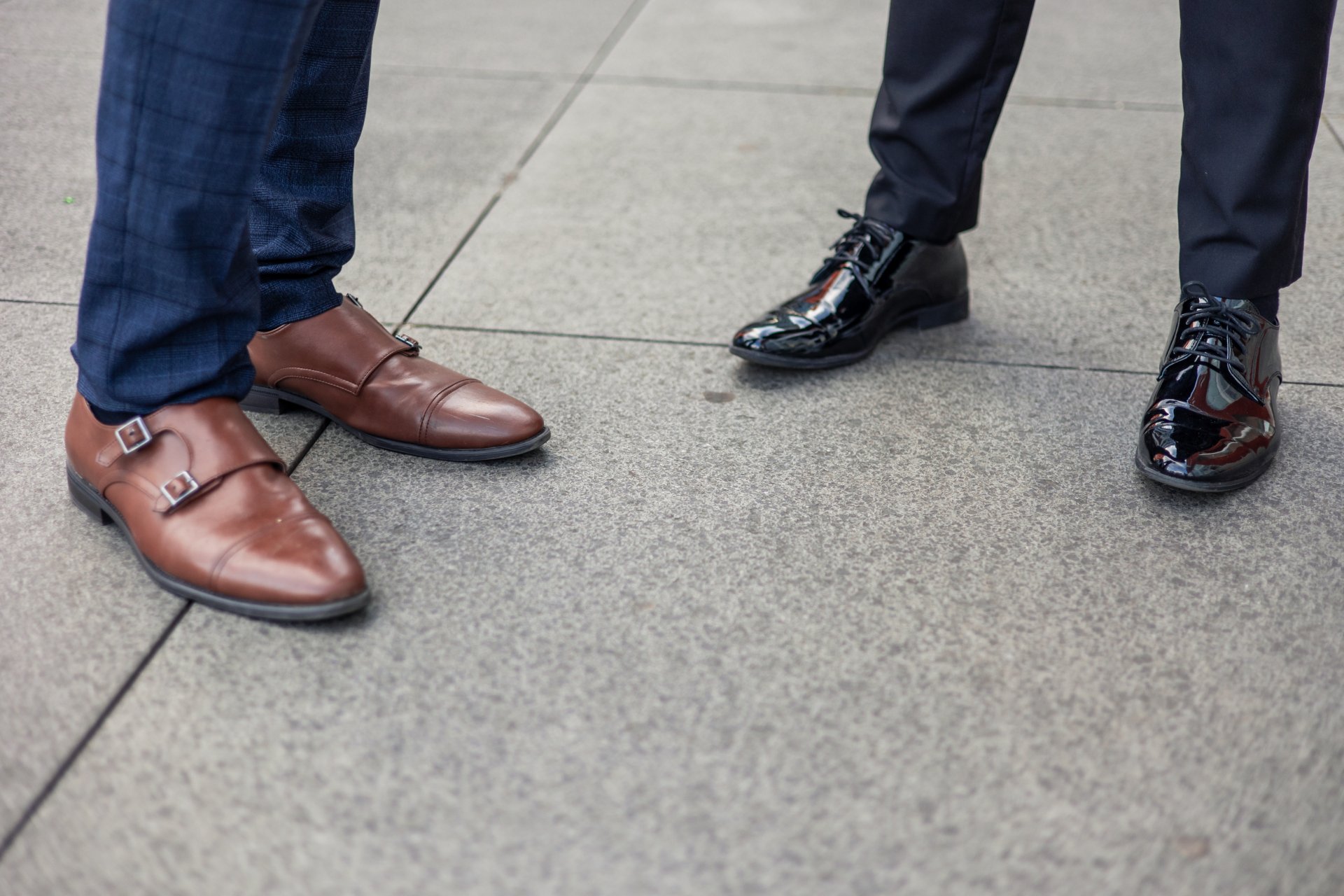
I am sitting at my kitchen table right now wearing two pairs of black dress shoes. If Jessica were to come home right now she would question my sanity.
Shoe #1 cost me $59.99. It was on clearance at Nordstrom Rack last year.
Shoe #2 cost me $495. I ordered it online after receiving my tax return and somehow talked myself into believing I “needed” to know what shoes made with actual quality materials felt like. For science!
Ok, so if I’m sitting here…let’s say four feet away from myself…both shoes blend together. They are both black leather cap toe oxfords. To the average person, both shoes say “middle aged man with a real job who pays his taxes.”
But after months of wearing both of these shoes (yes I alternate between a $60 shoe and a $500 shoe, I’m that type of nerd), there is a stark contrast between the way these shoes feel and perform. Much more of a difference than I originally anticipated when I decided to do this little experiment.
It all started with one of my eighth grade students. Marcus, a bright, kind-hearted kid with an old soul asked me last fall during parent conferences if I shopped at the same store his dad works at. His dad works at a gas station. Literally nothing wrong with that…but when your eight grade student catches you wearing “unprofessional” dress shoes it might be time to see what the hell you are supposed to buy.
Because let’s be honest, dress shoe advice on the internet is pretty dismal. “Just buy these $40 shoes from Payless” or “Spend your whole paycheck on these $800 handmade Italians shoes that Guiseppe made with his bare hands.”
What about everyone in between? What about middle class people like teachers, bankers, regular folk who need to look sharp at work but don’t have the means (or need) to spend $500 on shoes?
Well I decided to do some science. Bought my cheap pair first since $60 is nothing to scoff at but won’t kill me either. Wore those for about six months then did some noticing and proceeded to buy the expensive pair to see what all the hype was about.
Ok so here’s the thing. There is a difference. And it’s a frustrating, fantastic difference.
The materials.
Look we aren’t shoe experts. At least I’m not. But learning about how dress shoes are constructed and what you should pay attention to when buying has been an eye-opening experience.
The cheap shoe is made from what’s labeled “genuine leather.” Had no idea what that meant so I looked it up. As it turns out genuine leather is the lowest quality leather that you can buy. Sounds impressive right? Nope, it’s actually just industry speak for “we used the better parts of the hide to make these $300 shoes, now we are going to sell you the scraps.” The leather is coated with plastic, very processed, and overall looks and feels fake.
I didn’t know that when I bought the shoes. Genuine leather sounds like you are getting genuine leather! So I did more research. Hours of research that had me googling things like “what is wrong with genuine leather” late at night. Trust me when I say there are some messed up things happening in leather grading that I will never, ever understand.
One of the nicer things about the $500 shoe? It’s made from full grain calfskin. Full grain means it’s the highest quality of leather you can get. Full grain leather is the top layer of the hide, with all the natural grain intact. It’s not coated with any plastic finishes or other materials. The one downside? When my expensive shoe arrived it actually looked worse than the cheap shoe because the leather wasn’t coated. You can see natural markings and blemishes in the leather. But after about six months of wear the expensive shoe looks better than when I bought it compared to the shredded mess that is the $60 shoe.
The way they crease is night and day. The cheap shoe has these horrible stiff lines all across the toe box. It looks like someone took a ruler and scored the shoe front to back. The $500 shoe has nice soft creases that enhance the shoe.
But where they really differ is on the bottom. The cheap shoe has this rubber sole that is made to look like leather but feels sticky and fake. Worst of all? It’s glued onto the shoe. Yes glued. If the sole wears down you’re SOL because there is no way to repair those types of shoes. Take them to your local cobbler and he’ll chuckle at you then tell you to toss them when they stop being usable.
My nice shoe has what’s called Goodyear welt construction. Basically meaning the leather sole is stitched to the shoe itself so that when the sole wears down you can have it replaced. My cobbler in downtown Columbus snickered when he saw I had them glued when I brought them in (now I have my own personal cobbler. Makes me feel rich and incredibly old at the same time.) but lit up like a Christmas tree when I told him they were Goodyear welted. Says he has customers who have had the same shoes for forty years because they have just resoled them over and over.
Who the hell resoles their shoes?! Me…now.
The inside:
Hold on, let me cut open my shoe..
When I cut open my $60 shoe, I discovered cardboard. No not just cardboard. The kind of cardboard that feels like it belongs in a cereal box. There is structural cardboard underneath the insole, in the heel counter, the arch support. It’s fibber board. Feels solid when you first get the shoes but falls apart after months of wear.
This is what happens when my shoes start to fall apart. The material in the sole compresses. Your shoes go from feeling snug and supportive to feeling like you’re wearing house slippers. And it all happens in a few short months.
My $500 shoes? 100% leather insole, heel counter, and lining. Like I mentioned earlier leather gets better with age. The more you wear your shoes the mold the leather insoles will actually start to conform to the unique shape of your feet. Develop stress points that are customized to how your feet strike while you wear the shoes. Your shoes actually fit better the more you wear them!
Which brings me to breaking them in.
Holy crap these shoes hurt my feet. Remember how I said the cheap shoe felt like cushy plop-mallows? The expensive shoe felt like wooden cubes. You would have thought I jumped into a pool wearing these damn shoes for the first month I owned them. Every.single.step.hurt.
Fast forward three months. My feet have molded to the shape of the shoes, the cork underneath the insole has compressed to the arch of my feet, and I have shoes that feel like they were made specifically for me. I can wear these $500 shoes for twelve hour days and not give my feet a second thought. The cheap shoes finally reached comfortable about the same time the started falling apart.
Jessica was the first to notice. Asked me why I hadn’t been complaining about my feet hurting when I got home from conferences last fall. It took me living in pain for a month to realize that I had accepted dress shoes being uncomfortable as normal. Having shoes that fit comfortably were life changing.
Appearance:
They both look like shoes right? From afar nobody would notice. Take a closer look though and you can really see the difference. Full grain leather develops nice sharp creases. The leather has variation and depth to it. The toe cap was hand burnished giving it subtle shades of black. The edges of the sole were stitched and refinished with layers of dye and wax.
My cheap shoe looks how it was made. Machine stitched with no real attention to detail. Again nothing wrong with that…but when you start comparing the two that’s where you notice.
Cost per Wear:
Wait what?! There’s math involved?
The $60 shoe lasted me about eight months before it was no longer wearable. Regular rotation, meaning I wore them twice a week maybe. After eight months the leather started cracking along the creases (remember how horrible those are up top?) the rubber sole started wearing thin, and overall the shape just looked horrible. Time to buy another pair or start rocking clown shoes to work.
I am currently at eighteen months on my $500 shoes and they have probably looked better than when I first bought them. With regular maintenance (ie dropping them off at my cobbler every year to resole them) they should last me ten+ years. So $60 every eight months vs $500 plus maybe $200 in resoling every ten years. Does the math work out? Hell yeah. But it feels ten times better putting on a quality pair of shoes over something that was pre-owned by your dog.
Unless, of course, you gain an inch in height or the particular style of shoe goes out of fashion. Shoes are the one fashion item that seems to evolve every few years. What was stylish in dress shoes ten years ago will look drastically different than what’s in style today. But if you shop wisely $500 shoes should last you a long time.
BUT..and this is a big but. If you’re like me and live in constant fear of your shoe size changing by .none (why do shoes shrink over time?!?) you can likely get almost all the benefits of a $500 shoe for $200-$300.
There are tons of brands that use Goodyear welted construction with all leather interiors for under $300. Brands like Meermin, Grant Stone, and even Allen Edmonds (on sale) are great alternatives to the $500 shoes I purchased. I actually just bought a pair of Meermin dress shoes that retailed for $295 and were on sale for $195 shipped.
They’re not anywhere near the quality of my $500 shoes but for less than half the price I wasn’t expecting that. They don’t have the highest quality construction or leather, but they are still resoleable, comfortable after they’re broken in, and provide a professional appearance when I wear them to work.
Shoes in the $100-150 price range are the worst value IMHO. You’re basically just paying double for the convenience of not buying from Payless. The shoes in that range are usually still glued and made with processed leather.
It’s like buying a $40,000 Honda Civic. Sure that Honda will perform plenty well and get you from point A to point B but you’re still buying a Honda.
Here’s a little tip I wish I would have learned earlier. Head to eBay and start buying used shoes from high quality manufacturers. Allen Edmonds and many other popular dress shoe brands show up on ebay all the time for half price. Have them refurbished at your local cobbler (another $75-100) and boom. Nice shoes for the cost of refurbished shoes.
How did I get my first pair of nice shoes? Ordered a used pair of AE’s on ebay for $100 shipped then spent another $100 getting them broken in and resignled by my cobbler. Was literally making half of what I make now and still managed to snag a great pair of shoes. Quality shoes last a long time when they’re taken care of. A pair of $500 shoes that’s been worn for five years and properly cared for is still structurally sound. They just need some new sole and to be brought back to life.
What I never anticipated was how much nicer I felt wearing my $500 shoes. Don’t get me wrong a lot of this is mental. Once you know you have shoes that can handle getting dressed everyday and won’t fall apart you’ll feel better about wearing them. But I genuinely feel like I walk taller, I sit up straighter, and have more confidence wearing shoes that fit well and look good. My students haven’t said anything outright but I swear they look up to me more when I’m wearing the nicer shoes. Could be a placebo, could be that I know my shoes look good and am acting more confident. Doesn’t matter, it works.
I also have found myself becoming way more particular about how I care for my shoes. Shoe trees (yes the cedar kind), shoe cream, leather conditioner, horsehair brush. Jessica teases me because I spend fifteen minutes every Sunday night meticulously conditioning my shoes after a long week. But if you spend $500 on shoes you start caring about keeping them in nice condition.
Helllloooo drunk eBay purchases at 2AM.
But for most guys out there I would recommend sticking to that $200-300 sweet spot. You’ll be able to get nicely constructed shoes with all leather interiors that will look professional without breaking the bank. Save your $500 for when you’re actually wearing dress shoes daily or when you hit the lottery.
Shoes that cost $60? Wear those when you need to elevate your casuals. Keep a pair at work for days when you need to look more professional than khakis and a button up. Great for weddings, interviews, or other occasions where you’ll wear them once or twice then not need again for years.
But if you’re like me and wear dress shoes on the reg spend a little more money. Don’t feel you need to spend $500 but definitely don’t buy shoes in the $100 range either.
Moral of the story? There is definitely a huge difference in cost vs. value when it comes to dress shoes. But that difference hits a point of diminishing returns pretty quickly.
The difference between my $60 shoes and my $300 shoes is night and day. Hell I can tell the difference between my $300 shoes and my $500 shoes on close inspection. But would I be willing to pay twice as much for that level of quality? Not unless I were a shoe blogger who wore dress shoes every day.
9 out of 10 people wearing dress shoes can’t tell the difference between your $300 shoe and your $500 shoe. What they can tell is the difference between something that fits, looks appropriate for the occasion, and is well cared for vs. doesn’t.
Make sure you get those things right before you start diving into the world of men’s dress shoes. Learn the differences in quality. Once you know genuine leather from full grain, stitched vs glued, disposable vs. repairable you can make an informed decision on what level of shoe is right for you instead of gambling every time you buy a new pair.
Now if you’ll excuse me Jessica is home early and I need to put these shoes back in the box.
EDIT: Somebody please tell me how to make a picture take up multiple paragraphs… Help a guy out.